QA FEATURE — From Pilot to Production: Why Agentic AI Governance Is Becoming a Board Issue
AIAPAC EDITORIAL QA FIXTURE · FEATURED STORY QA FEATURE — From Pilot to Production: Why Agentic AI Governance Is Becoming a Board Issue FICTIONAL TEST CONTENT — DO NOT PUBLISH Article Editor Fixture Metadata Editor Field Fixture Value Title QA FEATURE — From Pilot to Production:
AIAPAC EDITORIAL QA FIXTURE · FEATURED STORY
QA FEATURE — From Pilot to Production: Why Agentic AI Governance Is Becoming a Board Issue
FICTIONAL TEST CONTENT — DO NOT PUBLISH
Article Editor Fixture Metadata
Speaker Profile Fixture
| Name: Arjun Mehta Role: Chief Technology Officer Company: Horizon Systems India Slug: arjun-mehta Bio: Fictional technology leader used only for QA fixture data. |
|---|
Article Body
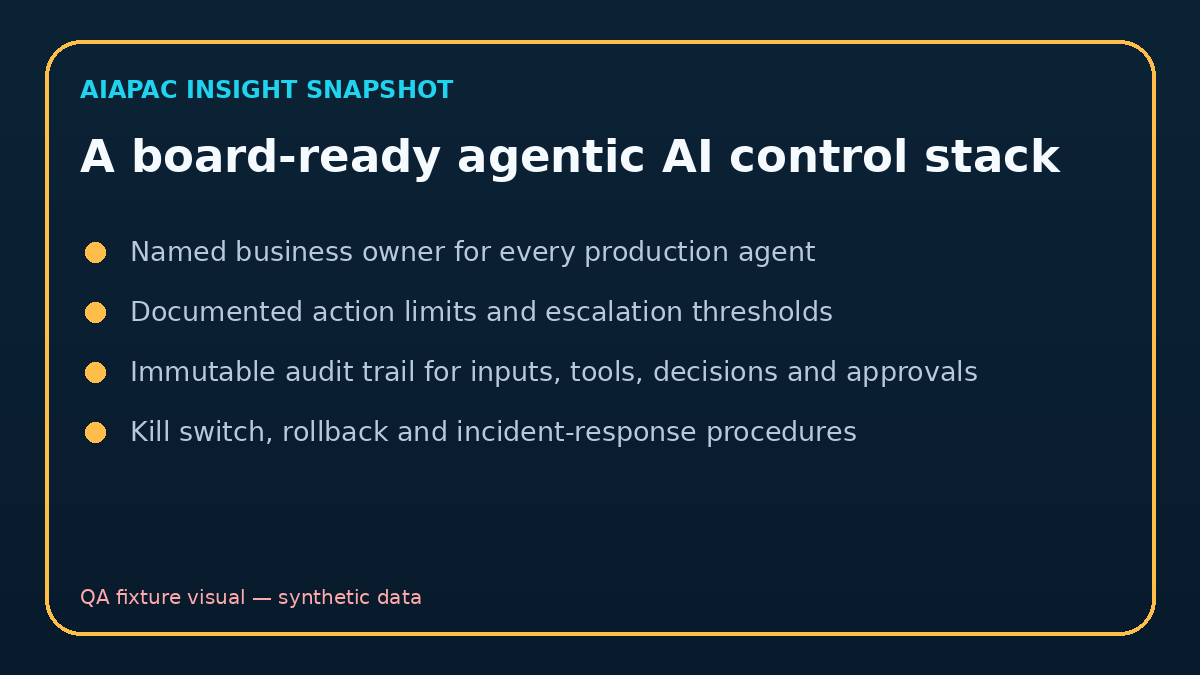
Inline media caption: Synthetic QA visual for embedded-media testing.
Approval is not a weakness
Some teams see human approval as evidence that automation is incomplete. Mehta takes the opposite view. High-value enterprise automation often improves when machines handle preparation and humans retain the final decision at regulated or irreversible points. The goal is to concentrate human attention where judgment matters, not to maximize the percentage of decisions made without people.
Financial services as an early proving ground
Banks and fintechs already operate with detailed controls, maker-checker patterns and audit requirements. Those practices can map naturally to agentic AI. A system might collect supporting evidence, classify a case and recommend an action, while an authorized employee approves the final outcome. The same pattern can extend to procurement, customer operations and enterprise security.
What a board dashboard should show
A useful board view would avoid technical model trivia and focus on exposure: how many production agents exist, what systems they can touch, what percentage of actions require human approval, how often overrides occur, what incidents have happened and how quickly controls can disable a workflow. That makes AI governance legible as operational governance.
The practical takeaway
The fictional scenario suggests that agentic AI governance is moving closer to existing enterprise risk disciplines. For AIAPAC QA, this fixture tests the Features category, Featured Story state, a canonical author and speaker, APAC/India taxonomies, financial-services sector assignment, featured media and complete search/AEO settings.
AEO / Direct Answer
Why should boards care about agentic AI governance?
Because agentic systems can take actions across business workflows, boards need clear limits, audit trails, accountability and escalation rules before those systems are scaled.
QA Safety Note
This article, all people, companies, quotations and claims are synthetic QA fixtures. Use them to test Article Editor persistence, Submission Queue conversion, taxonomy relationships, speaker media, feature-image generation and review workflows. Do not publish as real editorial content.