Australian Miners Apply AI to Geological Target Prioritisation
Exploration teams are using machine learning to rank geological targets across large datasets while keeping geologists responsible for final interpretation and drilling decisions.


SYNTHETIC EDITORIAL QA FIXTURE - not real reporting
Key takeaways
AI can surface patterns across geochemistry, geophysics, and historical drilling data that are difficult to review together manually.
Model outputs are being treated as ranked hypotheses rather than proof of mineralization.
Programs are judged by how well they focus field work, not by whether the model predicts a discovery on its own.
“The model should help a geologist ask a better question about the ground, not pretend that uncertainty has disappeared.”
Data layers become easier to compare
Exploration datasets can include decades of drilling logs, geochemical assays, magnetic surveys, satellite imagery, and structural interpretation. Machine learning can help teams compare those layers and identify areas that deserve closer review.
Rankings are not discoveries
Companies are presenting model results as ranked target zones with confidence and contributing factors. That framing helps geologists understand why an area is elevated without treating the output as a definitive resource estimate.
Field evidence still closes the loop
Field mapping, sampling, and drilling remain essential. New evidence is fed back into the model so the system learns where earlier assumptions were useful and where they failed.
Prioritisation may be the practical win
The economic value may come from spending scarce exploration budgets on better-prioritized targets. Even modest improvements in field focus can matter when drilling programs are expensive.
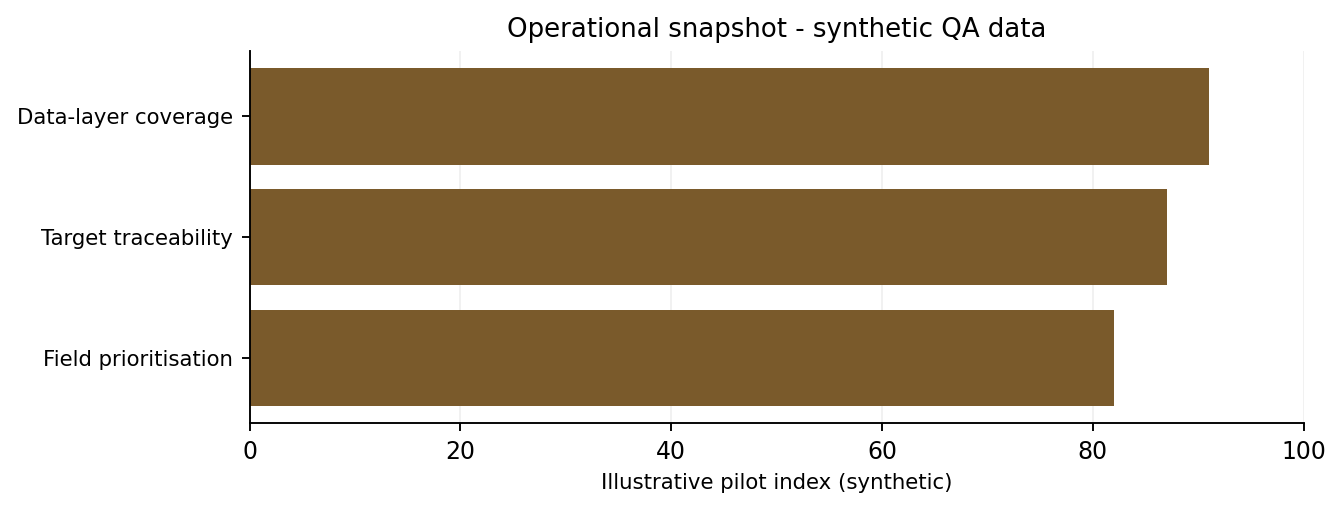
Synthetic data snapshot
| QA metric | Before / baseline | Pilot / after | Interpretation |
|---|---|---|---|
| Target review cycle | 21 days | 12 days | Faster screening |
| Priority targets with evidence links | 63% | 93% | Better traceability |
| Field visits per shortlisted target | 2.8 | 1.9 | More focused validation |
QA note: All organizations, metrics, quotations, people, and scenarios in this file are synthetic and created only to test editorial import, taxonomy mapping, rich-text preservation, images, charts, tables, quote handling, and article workflow behavior.