AIAPAC EDITORIAL QA FIXTURE · FEATURED STORY
QA FEATURE — The New Compute Corridor: Southeast Asia’s Race for AI-Ready Data Centres
FICTIONAL TEST CONTENT — DO NOT PUBLISH
Article Editor Fixture Metadata
| Editor Field | Fixture Value |
|---|---|
| Title | QA FEATURE — The New Compute Corridor: Southeast Asia’s Race for AI-Ready Data Centres |
| Slug | qa-fixture-southeast-asia-ai-data-centres |
| Kicker | INFRASTRUCTURE FEATURE |
| Summary / Dek | A fictional QA deep dive into how power, cooling, connectivity and policy could shape the next generation of AI-ready data centres in Southeast Asia. |
| Content Type | Feature |
| Workflow Status | draft |
| Payload _status | draft |
| Featured Story | TRUE |
| Author | Nina Santos (nina-santos) |
| Category | Features / features |
| Regions | Philippines, Southeast Asia |
| Sectors | Data Centres, Cloud Infrastructure |
| Topics | AI Infrastructure, Data Centres, Cloud Computing |
| Tags | AI infrastructure, data centres, Philippines, cloud, GPU computing |
| Speaker / Interviewee | Elena Cruz — Vice President, Infrastructure, Archipelago Cloud |
| Primary Speaker | Elena Cruz |
| Featured Image | 03_featured_qa-fixture-southeast-asia-ai-data-centres.png |
| Featured Image Alt | QA featured artwork for The New Compute Corridor: Southeast Asia’s Race for AI-Ready Data Centres |
| Feature Template | aiapac-features-editorial@1 |
| Speaker Profile Image | 03_speaker_elena-cruz.png |
| SEO Title | Southeast Asia’s AI-Ready Data Centre Race | AIAPAC |
| SEO Description | QA fixture about AI data centres, energy, cooling, connectivity and infrastructure investment across Southeast Asia. |
| Canonical URL | https://staging.aiapac.net/articles/qa-fixture-southeast-asia-ai-data-centres |
| Search Intent | informational |
| Focus Topic | AI-ready data centres in Southeast Asia |
| Supporting Topics | GPU infrastructure, energy, cooling, connectivity, sovereign cloud |
| Schema Type | Article |
| Structured Data | Enabled |
| AEO Question | What makes a data centre ready for AI workloads? |
| AEO Answer | AI-ready facilities need dense power delivery, advanced cooling, resilient connectivity, capacity planning for accelerators and operational controls that can support rapidly changing compute demand. |
| Content Owner | Editorial QA |
| Review Due | 2026-09-05 10:00 Asia/Manila |
| Publish At | Not scheduled |
| Unpublish At | Not scheduled |
| Trend Override | Disabled |
| Exclude From Latest | TRUE — QA safeguard |
Speaker Profile Fixture
| Name: Elena Cruz Role: Vice President, Infrastructure Company: Archipelago Cloud Slug: elena-cruz Bio: Fictional infrastructure executive created for Editorial QA. |
|---|
Article Body
INFRASTRUCTURE FEATURE
A fictional QA deep dive into how power, cooling, connectivity and policy could shape the next generation of AI-ready data centres in Southeast Asia.
AI changes the infrastructure equation
The data-centre market has always been shaped by power, land, fibre and customer demand. AI intensifies every constraint. In this fictional QA article, Archipelago Cloud infrastructure vice president Elena Cruz says accelerator clusters concentrate much more computing power into each rack, forcing operators to redesign electrical distribution, cooling and capacity planning.
Power becomes the first site-selection filter
For conventional workloads, a development could expand incrementally as customer demand arrived. Large AI clusters create sharper step changes. Operators need confidence that grid connections, backup systems and long-term generation plans can support future density. Cruz says this shifts site selection toward markets where utilities, developers and policymakers can coordinate years ahead.
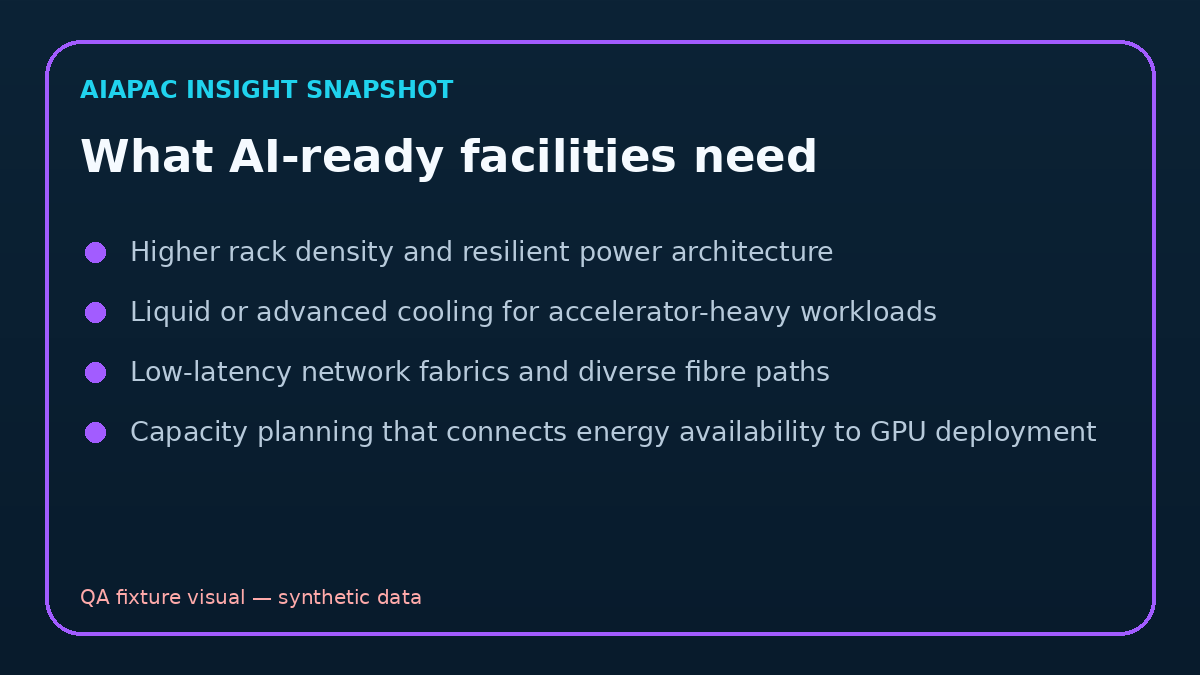
Inline media caption: Synthetic QA visual for embedded-media testing.
Cooling is now a strategic design choice
Accelerators generate enough heat that traditional air cooling can become inefficient at high density. Liquid cooling, rear-door heat exchangers and hybrid designs are therefore moving from specialist configurations into mainstream AI infrastructure planning. The engineering decision affects building layouts, maintenance practices and even how customers specify hardware.
Connectivity still determines useful compute
A powerful cluster is not useful if data and users cannot reach it reliably. Southeast Asia’s archipelagic geography and cross-border traffic patterns make network diversity especially important. Operators increasingly plan for multiple subsea and terrestrial routes, cloud on-ramps and direct interconnection with enterprise networks.
The Philippines opportunity
In this fictional scenario, Cruz sees the Philippines as a potential part of a broader regional compute corridor, supported by a large digital economy and improving connectivity. The challenge is to pair demand growth with durable power and permitting strategies. Similar trade-offs are playing out in Malaysia, Indonesia, Thailand and other markets.
The practical takeaway
AI infrastructure is making data centres more tightly coupled to national energy and connectivity planning. For AIAPAC QA, this story tests infrastructure taxonomies, a Philippines/Southeast Asia regional relationship, a speaker profile, Featured Story state, generated feature art, inline media and complete SEO/AEO metadata.
AEO / Direct Answer
What makes a data centre ready for AI workloads?
AI-ready facilities need dense power delivery, advanced cooling, resilient connectivity, capacity planning for accelerators and operational controls that can support rapidly changing compute demand.
QA Safety Note
This article, all people, companies, quotations and claims are synthetic QA fixtures. Use them to test Article Editor persistence, Submission Queue conversion, taxonomy relationships, speaker media, feature-image generation and review workflows. Do not publish as real editorial content.