Philippines Logistics Firms Use Predictive Routing to Manage Island Delays
Operators are combining port schedules, weather signals, vehicle capacity, and historical handoff data to anticipate disruptions across inter-island delivery networks.


SYNTHETIC EDITORIAL QA FIXTURE - not real reporting
Key takeaways
Inter-island routes depend on port cutoffs, sailing availability, road conditions, and the timing of multiple handoffs.
The strongest pilots combine model recommendations with dispatcher rules for vessel changes, priority cargo, and customer commitments.
The next challenge is network-wide learning without losing the local knowledge that dispatch teams use during disruptions.
“A useful route plan should explain the next best action before a missed connection becomes a customer escalation.”
Island networks create linked uncertainties
Inter-island routes depend on port cutoffs, sailing availability, road conditions, and the timing of multiple handoffs. A delay at one transfer point can change the feasible options for every downstream leg. Predictive tools are being tested to surface those dependencies earlier than conventional milestone alerts.
Dispatch rules remain part of the model
The strongest pilots combine model recommendations with dispatcher rules for vessel changes, priority cargo, and customer commitments. Teams can compare alternative routes while preserving limits that may not be obvious from historical data alone. That makes the output easier to act on during busy operating windows.
Customer updates become more proactive
When systems estimate connection risk before a shipment is officially late, account teams can offer revised delivery windows or alternate arrangements sooner. The benefit is not only faster routing. It is also a more consistent explanation of what changed and which recovery option is being used.
Local knowledge will shape scale
The next challenge is network-wide learning without losing the local knowledge that dispatch teams use during disruptions. Operators need a practical way to record overrides, unusual port conditions, and temporary carrier constraints so future recommendations improve rather than repeat the same mistake.
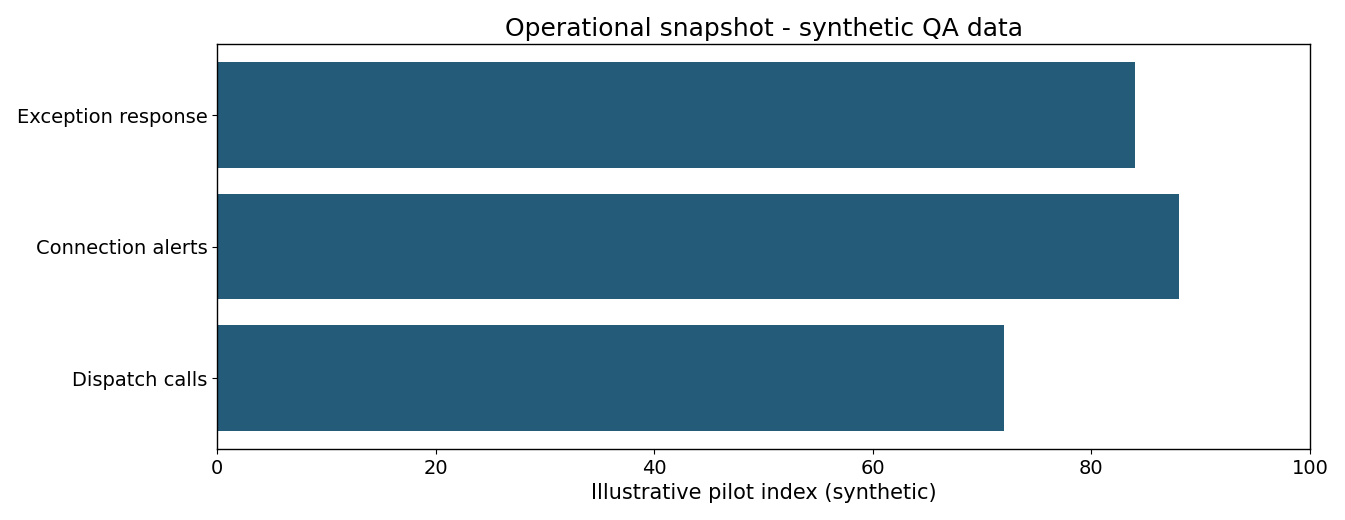
Synthetic data snapshot
| QA metric | Before / baseline | Pilot / after | Interpretation |
|---|---|---|---|
| Route exception response | 42 min | 18 min | Faster recovery decisions |
| Late-connection alerts | 61% | 87% | More proactive warnings |
| Manual dispatch calls | 24/day | 11/day | Fewer status checks |
QA note: All organizations, metrics, quotations, and scenarios in this file are synthetic and created only to test editorial import, taxonomy mapping, rich-text preservation, images, tables, and quote handling.