Thailand Hospitals Test AI Workflow Support for Medical Imaging
Hospitals are testing AI to prioritize imaging worklists and prepare structured observations while keeping diagnostic interpretation with licensed clinicians.
SYNTHETIC EDITORIAL QA FIXTURE - not real reporting
Key takeaways
Workflow AI can help surface urgent studies sooner without making the final diagnosis.
Hospitals are measuring false-negative risk and escalation behavior, not only average reading speed.
Clinical deployment depends on integration with existing imaging and reporting systems.
“The system should help the right study reach the right clinician sooner. It should not blur who is accountable for the diagnosis.”
Triage targets workflow pressure
Radiology teams can face large and uneven work queues. AI-assisted triage ranks studies using predefined findings and operational urgency so clinicians can review potentially time-sensitive cases earlier.
Safety metrics go beyond speed
Hospitals are tracking cases the model misses, cases it over-escalates, and how clinicians respond to conflicting signals. Those measurements are more important for safety than headline reductions in average reporting time.
Integration determines usability
Useful deployments connect directly with picture archiving and reporting systems. Additional logins or separate viewers can erase the time saved by automated prioritization.
Clinicians remain the final interpreters
The model can organize the queue and prepare draft observations, but the radiologist remains responsible for interpretation, reporting, and communication with the care team.
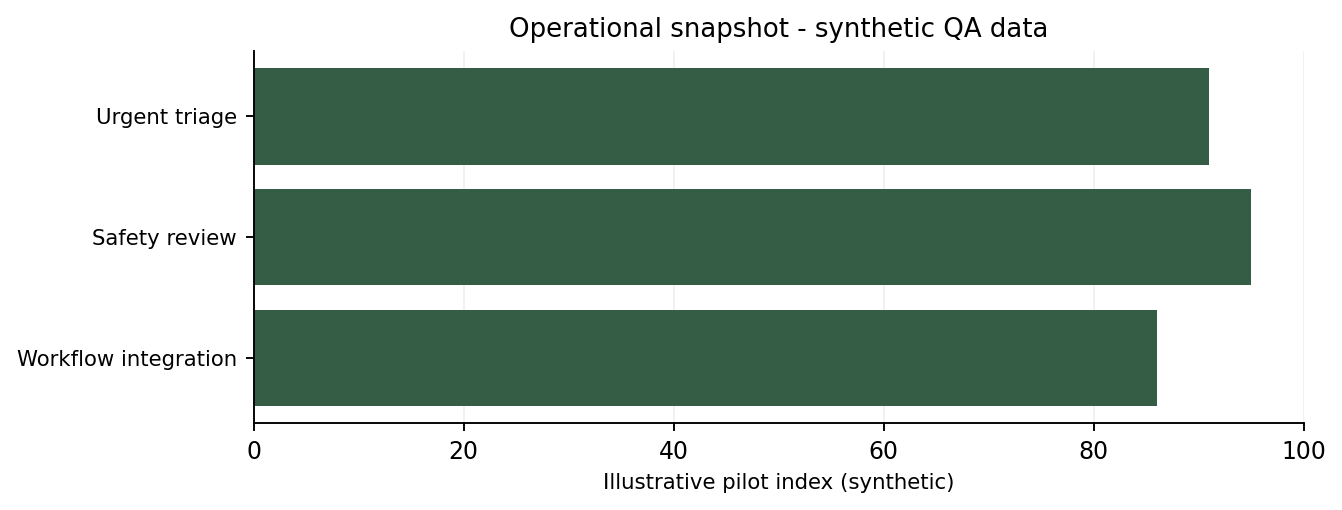
Synthetic data snapshot
| QA metric | Before / baseline | Pilot / after | Interpretation |
|---|---|---|---|
| Urgent-case queue time | 38 min | 21 min | Faster prioritization |
| False escalation rate | 14% | 7% | Cleaner triage |
| Integrated workflow adoption | 58% | 89% | Higher clinician use |
QA note: All organizations, metrics, quotations, people, and scenarios in this file are synthetic and created only to test editorial import, taxonomy mapping, rich-text preservation, images, charts, tables, quote handling, and article workflow behavior.